-

-
-
En
-

When you build a solar farm on land, the biggest worries are usually about land acquisition and grid connection. But when you take solar panels out to sea, everything changes.
The ocean is unforgiving. It tests every bolt, every weld, and every coating in ways that land-based systems never experience. For project developers, EPC contractors, and investors looking at offshore solar, understanding these technical challenges isn't optional—it's the difference between a 25-year asset and a costly failure.
Here are the six critical technical challenges of marine solar panel mounting systems, and how modern engineering is solving them.
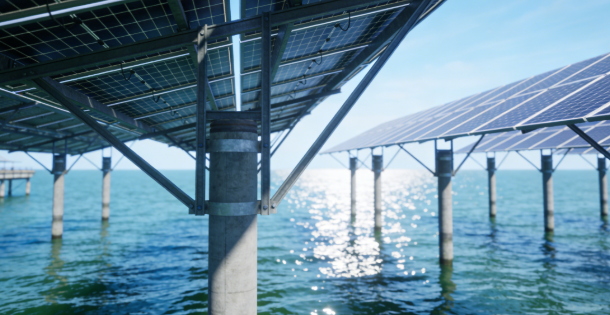
Salt is the ocean's most persistent enemy of metal structures. Unlike fresh water, seawater carries dissolved salts that create a highly conductive electrolyte. When this salt spray settles on solar mounting structures, it accelerates electrochemical corrosion at an alarming rate.
A standard galvanized steel structure that lasts 25 years in a inland solar farm might fail in less than five years in a marine environment. The corrosion isn't always visible at first—it starts at microscopic levels, eating away at grain boundaries, then progresses to pitting, and finally to structural failure when you least expect it.
The engineering solution lies in multiple layers of protection. First, material selection matters: offshore-grade aluminum alloys or high-strength steel with enhanced corrosion resistance form the foundation. Second, the coating system must be marine-grade—typically a hot-dip galvanization process with additional zinc-rich epoxy coatings. Third, cathodic protection systems can be added for submerged components, using sacrificial anodes that corrode instead of the structural steel.
Modern floating solar racking now undergo rigorous salt spray testing according to ASTM B117 standards, typically lasting 1,500 to 3,000 hours without red rust—a critical specification that buyers should always verify.
The ocean has no trees, no buildings, and no hills to break the wind. Solar panels mounted offshore face the full, unfiltered force of nature's strongest winds. A single solar panel acts like a sail—multiply that by thousands of panels, and you're looking at enormous lateral forces trying to push your entire structure over.
The challenge isn't just about maximum wind speed. It's about turbulence, gust factors, and the dynamic interaction between wind and structure. Typhoons don't blow steadily—they come with violent gusts that can resonate with a structure's natural frequency, creating amplification effects that static calculations miss.
Wind tunnel testing has become essential for large offshore projects. Physical scale models placed in wind tunnels reveal pressure distributions that computer models alone cannot predict. Modern mounting systems incorporate aerodynamic features: tilted panels at optimized angles, gaps between rows for pressure equalization, and streamlined structural members that reduce drag coefficients.
Foundation design must also account for overturning moments. Deeper piles, larger diameters, and increased concrete volumes are typical responses. Some projects now use helical piles or suction bucket foundations that provide greater lateral resistance in soft seabed conditions.
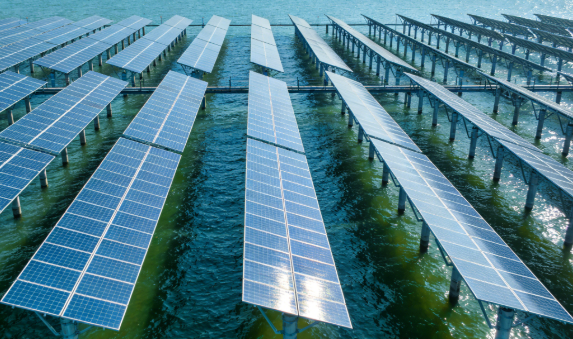
Wind comes and goes. Waves never stop. Every few seconds, another wave slaps against the structure. Each impact might be small, but over 25 years, that's hundreds of millions of load cycles—a textbook definition of fatigue loading.
Fatigue is insidious because it doesn't require stress levels high enough to cause immediate failure. Instead, microscopic cracks form, grow slowly with each cycle, and eventually reach critical size. By the time you see visible damage, the structure's remaining life might be measured in months.
The engineering response begins with understanding the wave environment. Significant wave height, peak wave period, and directional spectra all influence design loads. Structural engineers use spectral fatigue analysis, breaking down the wave climate into thousands of individual components and calculating cumulative damage using Miner's rule.
Connection details matter enormously. Welds are fatigue hotspots—every weld should be ground smooth to remove stress concentrations. Bolted connections need pre-tensioning to prevent fretting. Some designs avoid welds entirely in high-stress zones, using cast nodes or forged components with better fatigue performance.
Regular inspection protocols must be built into the design from day one. Access ladders, inspection walkways, and corrosion monitoring points aren't afterthoughts—they're essential features that determine whether your structure lasts 25 years or fails at year 12 with no warning.
Within weeks of installation, marine life discovers your nice new structure. Barnacles, mussels, algae, and tube worms attach themselves to every submerged surface. This isn't just a cosmetic issue—marine growth adds significant weight and dramatically increases the surface area exposed to waves and currents.
A steel pile that starts at 50 centimeters in diameter might effectively become 70 centimeters after two years of heavy fouling. The wave force on a cylinder increases with diameter—you're essentially making your own structure work harder against the sea. In extreme cases, marine growth thickness can exceed 200 millimeters, adding tons of extra weight across a large project.
Biofouling management requires a multi-pronged approach. For submerged zones, antifouling coatings containing biocides can slow initial attachment. Copper-based paints are effective but face increasing environmental scrutiny—newer formulations use silicone-based foul-release coatings that create a surface so slippery that organisms can't grip tightly.
For the intertidal zone (the area between high and low tide), mechanical cleaning may be necessary. Some projects design removable anodes and inspection ports specifically to allow periodic cleaning. The key insight: don't assume marine growth won't happen, and don't underestimate its structural impact during design.
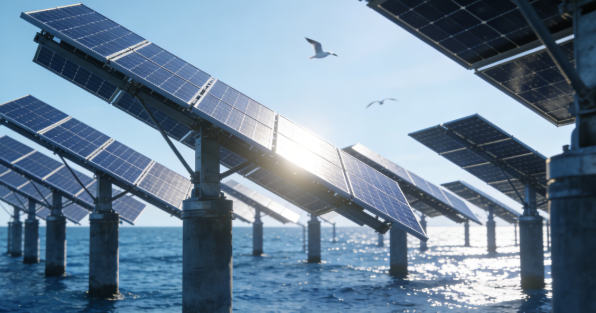
Building on land is predictable. You clear the site, bring in equipment, and work normal hours. Building offshore means working when the weather allows, which might be only 40 to 60 percent of the year in some locations. Every day of waiting costs money—crews, vessels, and equipment sit idle while you watch the weather forecast.
The installation challenge goes beyond schedule risk. Pile driving in the seabed requires precise positioning—a few degrees of tilt during driving can compromise the entire structure's ability to support panels. Underwater welding is expensive, slow, and requires highly specialized personnel. Lifting heavy components from barges onto piles during wave heave motion tests the limits of crane operations.
Modular design has emerged as the dominant solution. By pre-assembling large sections onshore—sometimes entire rows of panels complete with mounting structures—offshore work reduces to positioning and connecting modules. Some projects now use purpose-built installation vessels with motion-compensated cranes that maintain steady hook positions even as the vessel moves with waves.
Logistics planning becomes its own discipline. Storage yards near the launch site, careful sequencing of deliveries, and multiple weather windows built into the schedule separate successful projects from delayed ones. The best mounting systems are designed not just for final performance, but for ease of installation—simpler connections, fewer loose parts, and clear assembly sequences that reduce offshore labor hours.
Water and electricity don't mix—every child learns this. Yet offshore solar asks photovoltaic systems to operate in the most electrically challenging environment possible. Salt-laden moisture condenses on cables, penetrates connectors, and creeps into junction boxes. The same salt that corrodes steel also attacks copper conductors and compromises insulation resistance.
The stakes are higher than on land. A ground fault in an offshore installation isn't just a performance issue—it creates safety hazards for maintenance personnel who work in wet environments, and it can accelerate corrosion through stray current effects.
Component selection becomes critical. Connectors must meet IP68 or IP69 ratings (dust-tight and protected against continuous immersion). Cables need double insulation layers with seawater-resistant sheathing—standard PV cables designed for land use will fail within months. Some projects specify medium-voltage cabling with additional armor layers for submarine sections.
System design should minimize underwater connections. Where submerged connections are unavoidable, they require specialized wet-mate connectors designed for subsea use—a significant cost increase but non-negotiable for reliability. DC string lengths must consider higher voltage drops in marine conditions, and grounding systems need regular monitoring with automated fault detection.
The newest development is wireless monitoring. By reducing the number of physical connections needed for data collection, some projects are eliminating potential failure points entirely. Sensors attached to panels transmit data wirelessly to central collectors, removing kilometers of vulnerable data cabling from the system.
Offshore solar represents one of renewable energy's most exciting frontiers. But excitement must be tempered with respect for the marine environment. The six challenges above—corrosion, wind, waves, biofouling, installation, and electrical safety—aren't theoretical concerns. They're real-world problems that have already claimed poorly designed projects.
The good news? Engineering solutions exist. Marine-grade materials, thoughtful design, rigorous testing, and experienced installation teams can deliver offshore solar projects that perform reliably for 25 years and more.
For project developers and investors, the lesson is clear: ask the hard questions about how each challenge has been addressed. Look for test results, reference projects, and engineering credentials. In the ocean, there's no substitute for experience—and no shortcut to quality.
Ready to discuss your offshore solar project? Contact our engineering team to learn how our marine solar panel mounting systems address each of these challenges with proven solutions.

 CN
CN JP
JP